A Complete Guide to Using a Pneumatic Lithotripter in URS

Urinary stone disease remains a common urological condition worldwide, affecting both kidneys and ureters and often requiring interventional management. Among minimally invasive approaches, ureteroscopy has become a standard technique for visualising and treating stones within the urinary tract. During this procedure, stones are fragmented into smaller pieces that can be removed or passed naturally, reducing patient discomfort and recovery time. The effectiveness of ureteroscopy depends heavily on the reliability of the lithotripsy equipment used for intracorporeal stone fragmentation, making device selection an important aspect of modern endourology.
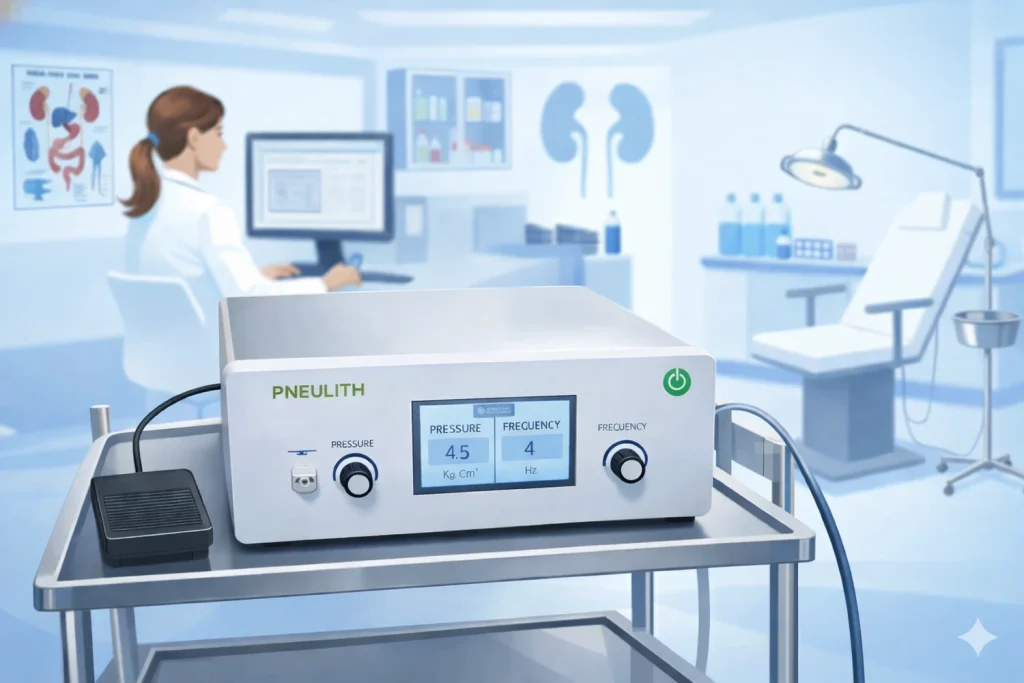
One widely adopted solution for this purpose is the pneumatic lithotripter, a mechanical stone fragmentation system used during ureteroscopy. It employs controlled bursts of compressed air to deliver kinetic energy directly to the stone, producing effective fragmentation without heat generation. Known for durability, cost efficiency, and consistent performance, pneumatic lithotripsy systems continue to be utilised across varied clinical settings, particularly where dependable stone-breaking capability and long-term operational value are essential in practice today.
How Pneumatic Lithotripters Work in Stone Fragmentation
A pneumatic lithotripter operates much like a tiny jackhammer or pellet gun inside the ureter or kidney. When the device is activated, a short burst of high-pressure air is released into the handpiece. This air pulse drives a small internal “bullet” or metal rod forward, which then strikes the tip of the probe against the stone. In effect, each air pulse sends a mechanical shockwave through the probe into the stone. Over many rapid pulses, the stone is shattered into sand-like particles or small fragments.
Importantly, this process generates almost no heat, unlike laser lithotripsy. There is essentially no thermal injury to surrounding tissue, which makes pneumatic lithotripsy inherently safe in terms of heat damage.
The stones shatter into pieces after each burst. These fragments then must be removed, usually with a small basket or grasper, or flushed out. Because each fragment is produced one by one, pneumatic lithotripters tend to push some pieces backwards (retropulsion) toward the kidney. In practice, this means you may need to chase or retrieve fragments during the procedure.
Advantages and Limitations of Pneumatic Lithotripsy
Advantages:
- Pneumatic lithotripters are prized for their durability and cost-effectiveness. The probes are reusable and rarely wear out; one probe can often be sterilised and used in dozens or hundreds of cases. Unlike delicate laser fibres, these metal probes are rugged. The equipment itself is relatively simple and less expensive than a laser generator, making it attractive to resource-conscious hospitals.
- Clinically, pneumatic lithotripsy has a high success rate. It excels at fragmenting very hard or large stones. This matches clinical experience that lasers sometimes stall on extremely dense stones, whereas the blunt force of a pneumatic probe can break them up.
- Another major plus is safety. Because pneumatic lithotripsy is essentially cold (no heat generation), there is minimal risk of thermal injury to the ureter or surrounding tissues. There is no issue of laser char or smoke, and no danger of inadvertent laser burns. The energy is delivered only at the contact point, so the effect on tissue beyond the stone is negligible.
Limitations:
- The primary drawback is stone migration and fragment management. Because each impact blasts pieces away, small fragments can be propelled either downward into the bladder or upward into the kidney. This retropulsion is more pronounced than with lasers. As a result, you will often need to manually extract fragments using baskets or forceps after fragmentation.
- Another limitation is that pneumatic lithotripters generally cannot dust a stone into sand fine enough to simply wash out. They break stones into chunks. For complete clearance, you must retrieve or pass the pieces. By contrast, modern lasers can often create “stone dust” with high-frequency bursts. So, if your goal is pure dusting, a laser or ultrasonic system might be preferred. Also, pneumatic probes fit only rigid or semi-rigid ureteroscopes.
Pneumatic Lithotripter vs. Other Lithotripsy Tools
In modern endourology, you have choices for how to break stones. Pneumatic lithotripsy is one among several lithotripsy equipment options. Let’s compare briefly:
Laser Lithotripsy:
Uses a holmium:YAG laser delivered through a thin fibre. This is extremely versatile and produces precise fragmentation with minimal migration. Lasers often yield slightly higher stone-free rates and are great for fine dusting. However, lasers are expensive to buy and maintain, and the fibres can break during use. Pneumatic lithotripters, in comparison, are far cheaper and require less ongoing cost (no disposable fibre). In terms of clinical outcomes, both are safe and effective, though lasers edge out a higher clearance rate.
Ultrasonic Lithotripsy:
These devices use high-frequency vibrations to break stones, often during percutaneous kidney procedures. They continuously aspirate fragments as they work. In URS, an ultrasonic probe can be used for large, soft stones or infected stones. However, ultrasonic probes are usually large and require a big working channel, limiting their use in URS. Pneumatic lithotripters are more compact. Ultrasonic devices also tend to be slower on very hard stones.
Electrohydraulic Lithotripsy (EHL):
This older method uses spark-generated shock waves inside a probe. It can fragment stones but carries a higher risk of ureteral injury due to shock waves. It’s largely been replaced by laser and pneumatic systems, which are safer and more controllable.
Conclusion
In summary, if you think of a pneumatic lithotripter system as a blunt but powerful tool, and a laser as a precise scalpel, each has its role. Many urologists choose based on case type and cost.
Pneumatic lithotripters continue to play a valuable role in ureteroscopy by offering a reliable, mechanical approach to stone fragmentation. Their proven effectiveness in managing hard and large calculi, combined with the absence of thermal injury risk, makes them a dependable option in modern endourology. Throughout this guide, we’ve explored how pneumatic lithotripsy systems work, their clinical applications, advantages, and important considerations for safe and effective use in URS. For healthcare facilities, understanding both the clinical performance and operational requirements of lithotripsy equipment is essential for informed decision-making.
If you are evaluating pneumatic lithotripter devices for clinical use or hospital procurement, our team is here to help. Contact us to discuss your requirements, request technical details, or explore solutions tailored to your urology practice or facility needs.
FAQs:
Pneumatic lithotripters are highly durable, reusable, and cost-effective. They provide strong mechanical fragmentation for tough stones (achieving high stone-free rates). Since they produce no heat, there is minimal risk of thermal injury to tissues. It often works faster on hard stones than some other methods. It is also a simple system with lower maintenance needs than laser equipment.
Pneumatic lithotripters excel at fragmenting very hard or large stones. For example, stones made of cystine or calcium oxalate monohydrate respond well to ballistic fragmentation. It is also very effective for single, large ureteral stones where quick fragmentation is needed. For smaller or softer stones, pneumatic works fine as well, but all the pieces need to be retrieved. It’s less suited for stones in areas only reachable with flexible scopes, since pneumatic probes fit only rigid/semi-rigid scopes.
You should weigh several factors: the cost of the console versus alternatives; durability and maintenance; and what accessories are included (probe sizes, scopes). Ensure compatibility with your existing ureteroscopes and availability of a medical air or gas source. Consider training needs and service plans. In sum, pneumatic systems offer good value and performance, especially where budgets are limited.