
How a Digital Pneumatic Lithotripter Works in Stone Management
Modern urology has moved far beyond open stone surgery, embracing minimally invasive technologies that are safer, faster, and more precise. Among these innovations, the digital pneumatic lithotripter has earned a trusted place in stone management by combining proven mechanical fragmentation with modern digital control. Designed for endoscopic use, it allows urologists to break urinary stones efficiently under direct vision while maintaining excellent control over energy delivery and procedural safety.
At its core, this technology relies on pneumatic lithotripsy principles, where controlled bursts of compressed air generate mechanical impact at the probe tip. These impacts are transmitted directly to the stone, causing it to fragment into smaller, manageable pieces without producing heat or damaging surrounding tissue. The addition of digital interfaces, pressure regulation, and programmable settings has refined this process, making treatment more predictable and user-friendly for clinicians.
Today, digital pneumatic lithotripsy systems are widely used for kidney, ureteral, and bladder stones. Their reliability, adaptability to different stone types, and compatibility with standard endoscopic workflows make them an essential tool in modern stone management practices.
What Is a Digital Pneumatic Lithotripter?
A digital pneumatic lithotripter is a medical device used during endoscopic surgery to break hard urinary stones into smaller fragments. Unlike extracorporeal shock wave lithotripsy (ESWL), which focuses energy externally, pneumatic lithotripters operate intracorporeally via a rigid or semi-rigid endoscope. A tiny probe is advanced through the scope to the stone under direct vision, and rapid pneumatic pulses are delivered to the probe tip to fracture the calculus.
These devices evolved from older analogue systems in which pressure was set by manual regulators and simple gauges. Modern digital lithotripters incorporate microprocessor controls, an LCD, and programmable settings. This digital interface provides real-time monitoring of system parameters and ensures precise, consistent pulses. In summary, a digital pneumatic lithotripter is essentially a digitally controlled pneumatic lithotripsy system: it combines the ballistic stone-breaking power of traditional pneumatic probes with modern electronics and safety features to fragment stones effectively while minimising trauma.
Clinical Applications of Pneumatic Lithotripters in Urology
Pneumatic lithotripters, especially the latest digital models, are widely used in urology to manage stones in various locations:
Kidney (Renal) Stones: Intracorporeal lithotripsy is often employed during percutaneous nephrolithotomy (PCNL) or ureteroscopy for medium to large kidney stones. Pneumatic energy is highly effective at breaking hard stones (e.g., calcium oxalate) in the renal pelvis or calyces. The robust “ballistic” action pulverises even large fragments, making it suitable for stones that resist ESWL. Digital controls let the surgeon optimise pulse strength and rate to complete stone removal efficiently.
Ureteral Stones: Rigid or semi-rigid ureteroscopy combined with a pneumatic lithotripter probe is a common treatment for ureteral calculi. The lithotripter’s small probes (0.8–1.2 mm) can navigate ureteroscopes to target mid or lower ureteral stones under vision. Pneumatic lithotripsy is effective at fragmenting impacted ureteral stones, often achieving rapid clearance without the need for open surgery.
Bladder Stones: Transurethral pneumatic lithotripsy is also used to treat bladder calculi. A rigid cystoscope and a 1.5 mm probe are passed through the urethra into the bladder. The pneumatic lithotripter breaks the stone into pieces that can be evacuated. This method is safe and fast for bladder stones up to ~3 cm in size.
Overall, digital pneumatic lithotripters play a versatile role in stone management. They are often combined with other modalities (e.g., holmium laser or ultrasound lithotripters) depending on stone type and location. Their low cost and safety profile make them especially valuable in resource-constrained settings and for large, hard stones.
Key Features of a PNEULITH Digital Pneumatic Lithotripter
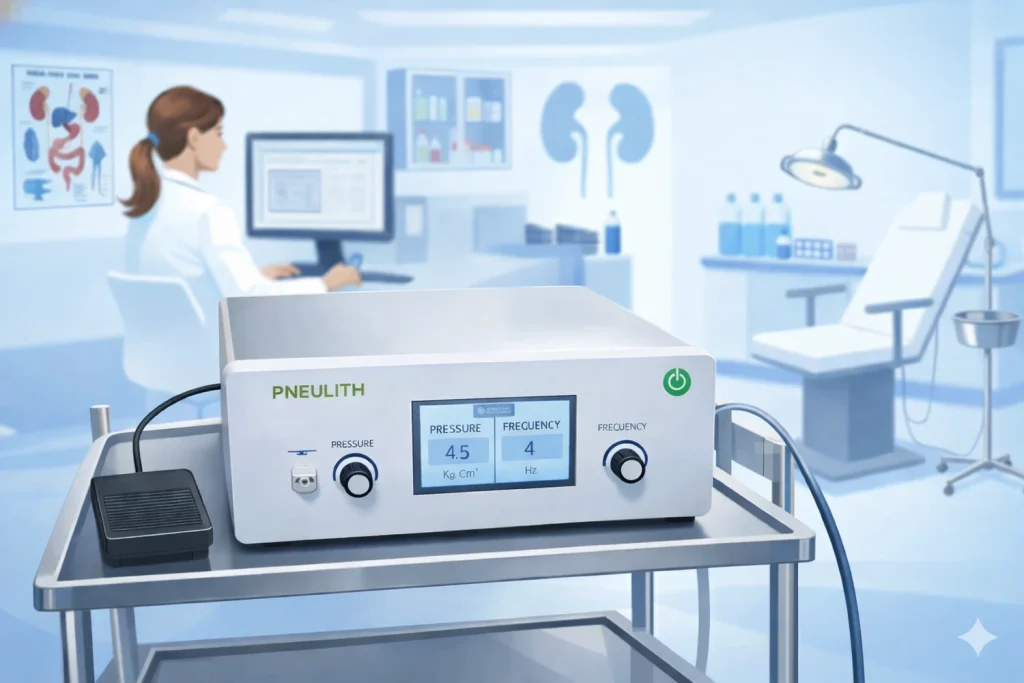
PNEULITH Digital Pneumatic Lithotripter is an example of a cutting-edge pneumatic lithotripsy system designed for contemporary urological practice. It incorporates numerous technical features aimed at ease-of-use and reliability. Key highlights of the PNEULITH system include:
Digital Control Unit: The PNEULITH runs on 230 VAC (50 Hz) power and accepts compressed air or pressurised oxygen as its energy source. Its microprocessor-controlled interface allows surgeons to adjust the working pressure (1.8–4.0 kg/cm²) precisely. An intuitive LCD touchscreen displays current pressure, pulse mode, and other parameters. Urologists can program preset protocols (specific pressure and frequency combinations) so the device automatically configures ideal settings during procedures.
Safety Features: The PNEULITH includes safety interlocks such as automatic low-pressure detection that pauses pulses if a leak is detected. Its electro-pneumatic regulator ensures stable pressure delivery, so pulses remain accurate and reproducible. By design, the probe tip does not generate heat, preventing mucosal damage even with continuous use.
Probe Options: The system comes with a range of probe diameters for different applications. Smaller probes (0.8, 1.0, 1.2 mm) are ideal for ureteroscopic work, while larger probes (1.5 mm) suit bladder stones, and 2.0 mm probes target renal calculi. These rigid probes transmit the pneumatic pulses efficiently for effective fragmentation.
Display and Interface: The clear digital display makes the PNEULITH user-friendly. Surgeons can easily monitor pressure and operating frequency. The device also offers single-pulse or continuous modes, with adjustable pulse rates from 1Hz to 15Hz in continuous mode. This level of control lets urologists tailor treatments in real-time.
Ergonomics and Portability: Built to be compact and portable, the PNEULITH unit can be carried between ORs. Its lightweight handpiece (about 150 g) reduces surgeon fatigue during lengthy procedures. Overall, the design emphasises durability and straightforward maintenance.
In summary, PNEULITH embodies an advanced pneumatic lithotripsy system with digital controls. It offers the proven efficacy of pneumatic stone fragmentation combined with modern features like program presets, real-time monitoring, and enhanced safety protocols. Hospitals looking to upgrade their stone management tools will find in PNEULITH a state-of-the-art solution.
Conclusion
Digital pneumatic lithotripsy represents a reliable and well-established approach to modern stone management. By using controlled pneumatic energy delivered through endoscopic instruments, this technology allows clinicians to fragment urinary stones effectively while preserving surrounding tissue. Throughout this discussion, we explored how pneumatic lithotripsy technology works, the role of digital control in improving precision, and why this method remains clinically relevant for managing kidney, ureteral, and bladder stones.
The integration of digital interfaces into pneumatic lithotripters has further enhanced procedural control and consistency. Adjustable pressure settings, real-time monitoring, and improved safety mechanisms support efficient workflows and predictable outcomes. These advancements make digital pneumatic lithotripsy systems a practical choice for healthcare facilities focused on minimally invasive, dependable stone treatment solutions.
If you are looking to upgrade or expand your stone management capabilities, Status Medical Equipments offers advanced pneumatic lithotripters designed for clinical reliability and ease of use. Contact us to request a quote today to equip your facility with dependable technology that supports confident, effective stone treatment.
FAQs:
A digital pneumatic lithotripter is an intracorporeal device used during endoscopic stone procedures. It fragments urinary stones by delivering controlled pneumatic (compressed air) impulses through a probe positioned directly against the stone under visual guidance.
Pneumatic lithotripsy is commonly used for kidney, ureteral, and bladder stones. It is effective for a wide range of stone compositions, particularly hard or dense calculi that require strong mechanical fragmentation during endoscopic procedures.
Yes, digital pneumatic lithotripsy is widely regarded as a safe and established technique when performed by trained clinicians. Digital control allows better regulation of pressure delivery, and the absence of thermal energy reduces the risk of heat-related tissue damage.

