Modern urology depends on precise functional assessment. Symptoms such as urgency, leakage, weak stream, retention, incomplete emptying, or pelvic floor dysfunction often require deeper investigation before treatment decisions are made. That is why a urodynamics measurement system has become an essential investment for hospitals, specialty clinics, and advanced diagnostic centres.
Today’s healthcare buyers expect more than a single-purpose machine. They need integrated technology that combines multiple studies, dependable software, expandable configurations, and consistent daily performance. In competitive healthcare environments, advanced diagnostics can increase specialist referrals, shorten decision time, and improve service reputation.
A platform that combines multiple studies and integrates reporting supports accurate diagnosis and higher department utilisation.
Why Hospitals Need Functional Precision
Urinary symptoms frequently overlap. Similar complaints may arise from obstruction, detrusor weakness, unstable contractions, sphincter dysfunction, or poor coordination. Treating these cases without measurable evidence can delay recovery and increase repeat visits.
A urodynamics measurement system allows clinicians to assess bladder filling pressure, urine flow pattern, voiding pressure, leak points, and muscle response under controlled conditions. This converts uncertainty into measurable findings that support better treatment planning.
Clearer diagnoses can shorten consultant decision time and reduce unnecessary treatment changes.
Urodynamic System Complete Diagnostic Modes
A modern urodynamic device should support routine and advanced studies on a single platform, enabling centres to handle broad clinical demand without fragmented equipment. A urodynamics measurement system with integrated modules reduces equipment duplication and simplifies scheduling.
| Diagnostic Mode | Clinical Purpose | Institutional Benefit |
| Uroflowmetry | Measures urine flow rate and urine flow curve | Quick frontline screening |
| Cystometry | Measures bladder pressure during filling | Better storage disorder diagnosis |
| Pressure Flow Study | Assesses voiding pressure and flow | Supports intervention planning |
| EMG Integrated Study | Evaluates pelvic floor coordination | Useful for complex dysfunction |
| Urethral Pressure Profiling | Measures urethral closure pressure | Advanced continence evaluation |
| Video Urodynamics | Imaging with pressure analysis | Premium specialty offering |
| Biofeedback Program | Supports pelvic floor rehabilitation | Adds therapy capability |
| Anorectal Manometry | Measures rectal sphincter function | Expands functional testing range |
Integrated testing helps facilities increase case capacity while reducing dependence on multiple standalone devices.
Software Efficiency Defines Daily Performance
In busy departments, software quality often matters as much as hardware. Staff need systems that are simple to operate, quick to calibrate, and efficient to report from.
A urodynamics measurement system should include searchable patient databases, study storage, calibration utilities, standard nomograms, graph review tools, print-ready reports, and smooth navigation. These features reduce administrative time and help maintain consistent output between users.
Doctors benefit from a cleaner consultation flow because organised data is easier to review and explain. Administrators benefit from faster patient movement and fewer reporting delays.
When software reduces setup and reporting delays, departments can schedule more studies each day.
Urodynamics Diagnostic System Commercial Value
Healthcare buyers measure outcomes beyond purchase price. A reliable urodynamics diagnostic system can create lasting value across operations and specialist services. A urodynamics measurement system also strengthens utilisation through multi-study capability.
- Higher throughput: Faster testing and reporting improve daily scheduling.
- More referrals: Advanced diagnostics attract consultants and outside doctors.
- Better utilisation: One system supports multiple studies and service lines.
- Improved records: Standard reports strengthen documentation quality.
- Reduced repeat testing: Stable data improves first-time confidence.
- Longer lifecycle value: Upgradeable architecture delays full replacement costs.
For growing institutions, these gains can offset higher upfront costs by improving utilisation and delaying replacement expenses.
Expandable Architecture Protects Capital
Clinical demand can rise quickly when a new specialist joins or referral volume increases. A fixed-function machine may become limiting within a short period.
That is why a urodynamics measurement system with modular upgrade paths offers stronger long-term value. Centres can begin with required studies, then add advanced capabilities as demand evolves. This staged investment model helps control capital spend while preserving future flexibility.
Expandable platforms are especially attractive for private hospitals, specialty clinics, teaching centres, and distributors serving different market segments. The right purchase should meet today’s needs without requiring an early replacement later.
Urodynamics Study Machine Buying Checklist
Selecting a urodynamics study machine should involve practical evaluation, not just brochure claims. Buyers should carefully assess real-world ownership factors. A urodynamics measurement system backed by responsive service support often delivers higher uptime over time.
- Stable pressure channels and accurate sensors
- Smooth calibration without repeated interruption
- Intuitive user interface for faster training
- Reliable patient data recall and storage
- Quick report printing and documentation flow
- Compact trolley or room-friendly footprint
- Responsive technical support and training
- Upgrade options for future expansion
These factors influence staff adoption, uptime, and post-installation ownership satisfaction.
Why Urodynamics Equipment Quality Matters
Low upfront pricing can be attractive, but hidden costs often surface later through downtime, poor support, unstable readings, or difficult servicing. These issues interrupt schedules and reduce clinician confidence.
Dependable urodynamics equipment should be engineered for regular hospital use, durable operation, stable signal capture, and maintainable design. A urodynamics measurement system built with quality components often delivers higher uptime and fewer service interruptions over the years of use.
For B2B procurement teams, ownership cost usually matters more than invoice value alone. Reliable equipment reduces cancelled appointments caused by downtime or unstable readings.
Use urodynamics systems that are installed, operated, and maintained by qualified professionals in accordance with applicable medical device regulations, manufacturer instructions, and healthcare facility safety protocols in your region.
Why NG UROCOMP-2000 Offers a Stronger Competitive Edge
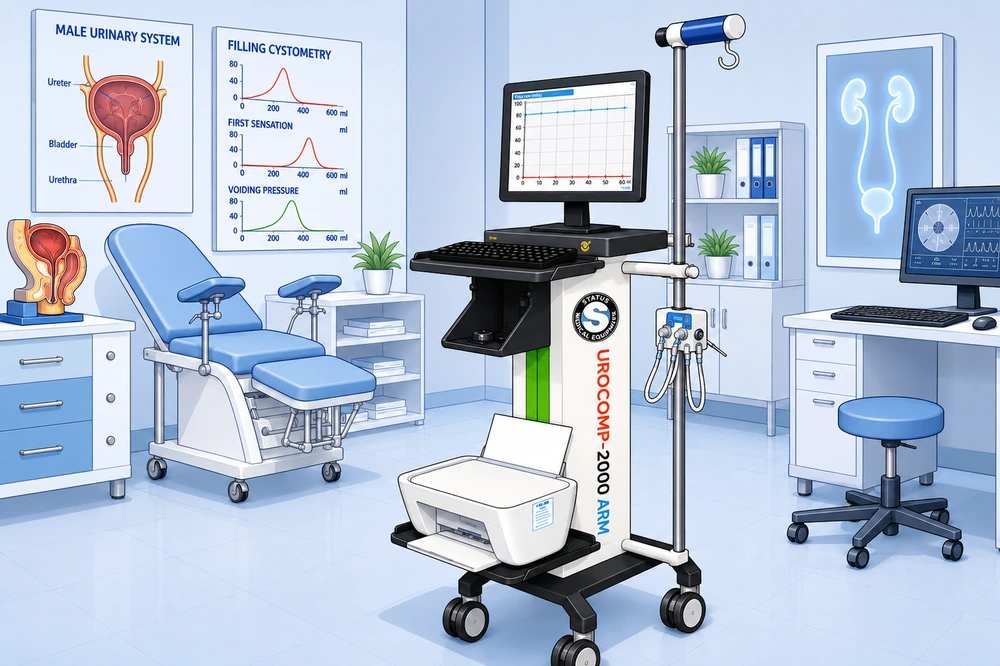
Among available market options, NG UROCOMP-2000 offers a sharper combination of capability, scalability, and operational practicality. It is available in multiple upgradeable models, allowing buyers to choose a configuration aligned with current needs while keeping future expansion options open.
The platform combines uroflowmetry, cystometry, pressure-flow studies, EMG-supported testing, urethral pressure profiling, video urodynamics, biofeedback, and anorectal manometry into a single ecosystem. This helps institutions consolidate diagnostics without later having to purchase fragmented systems. A urodynamics measurement system with this level of integration can reduce future procurement costs.
Its software environment supports patient data storage, easy search functions, calibration controls, standard nomograms, and organised report generation for faster workflows. Compact integration and practical setup also suit space-conscious departments.
Its combination of upgradeable models, integrated studies, and lower replacement pressure gives buyers stronger long-term value.
Conclusion
Selecting the right bladder diagnostic platform requires more than basic testing functions. A urodynamics measurement system should deliver integrated studies, efficient software, upgrade flexibility, stable performance, and strong ownership value. Institutions that invest strategically often achieve faster diagnosis, smoother workflows, and greater consultant confidence.
If your hospital, clinic, or distribution network is planning to upgrade urology diagnostics, contact our team at Status Medical Equipments and explore NG UROCOMP-2000 for a future-ready solution built for serious clinical performance.
FAQs:
Hospitals invest in a urodynamics measurement system to diagnose bladder problems more accurately. It helps doctors identify issues such as weak urine flow, leakage, retention, and pressure abnormalities while reducing repeated visits and delayed treatment decisions.
A modern urodynamics system should include uroflowmetry, cystometry, pressure-flow testing, patient data storage, calibration tools, reporting software, reliable sensors, and upgrade options for future clinical needs.
Modular design allows hospitals and clinics to start with essential testing functions and add advanced features later. This helps control upfront cost while supporting future growth without replacing the whole system.
Integrated systems combine multiple bladder diagnostic tests in one machine. This saves room space, simplifies staff training, reduces equipment purchases, and makes reporting easier from a single platform.
NG UROCOMP-2000 is attractive because it offers multiple testing functions, upgradeable models, organised software, and long-term usability. It suits hospitals, clinics, and distributors looking for scalable urology diagnostic equipment.