In modern endourology, performance is measured by outcomes, uptime, and efficiency. The digital pneumatic lithotripter is increasingly considered by hospitals and distributors because rigid URS procedures require reliable fragmentation power, intuitive controls, and minimal disruption to workflow. Buyers today no longer invest in equipment that only delivers in demonstrations.
Rigid ureteroscopy remains one of the most cost-effective approaches for treating ureteric stones. It can support efficient stone management and predictable procedural flow when matched with the right lithotripsy system. This makes equipment selection a strategic investment rather than a routine capital purchase.
For procurement managers, urology heads, and biomedical teams, the key question is simple: Which system delivers consistent performance, low maintenance, user-friendly operation, and long-term value? This is where a digitally engineered pneumatic device creates clear gains in uptime, usability, and maintenance efficiency.
Why Rigid URS Still Matters
Rigid ureteroscopy remains widely adopted because it balances clinical effectiveness with operational efficiency. For hospitals managing high patient volume, rigid URS can support dependable throughput while avoiding unnecessary complexity in standard stone cases. When paired with the right pneumatic lithotripter, departments gain both reliable stone treatment performance and practical workflow consistency.
Many facilities prefer rigid URS for lower and mid-ureteric stones because the method is familiar, efficient, and scalable across experienced teams.
- Stable access to lower and mid-ureteric stones
- Efficient case flow for scheduled theatre lists
- Lower procedural complexity in suitable cases
- Strong compatibility with established URS workflows
- Practical utilisation in high-volume urology centres
Rigid URS continues to hold value because it aligns clinical needs with predictable scheduling and smoother workflows.
Pneulith Lithotripter Power Delivery
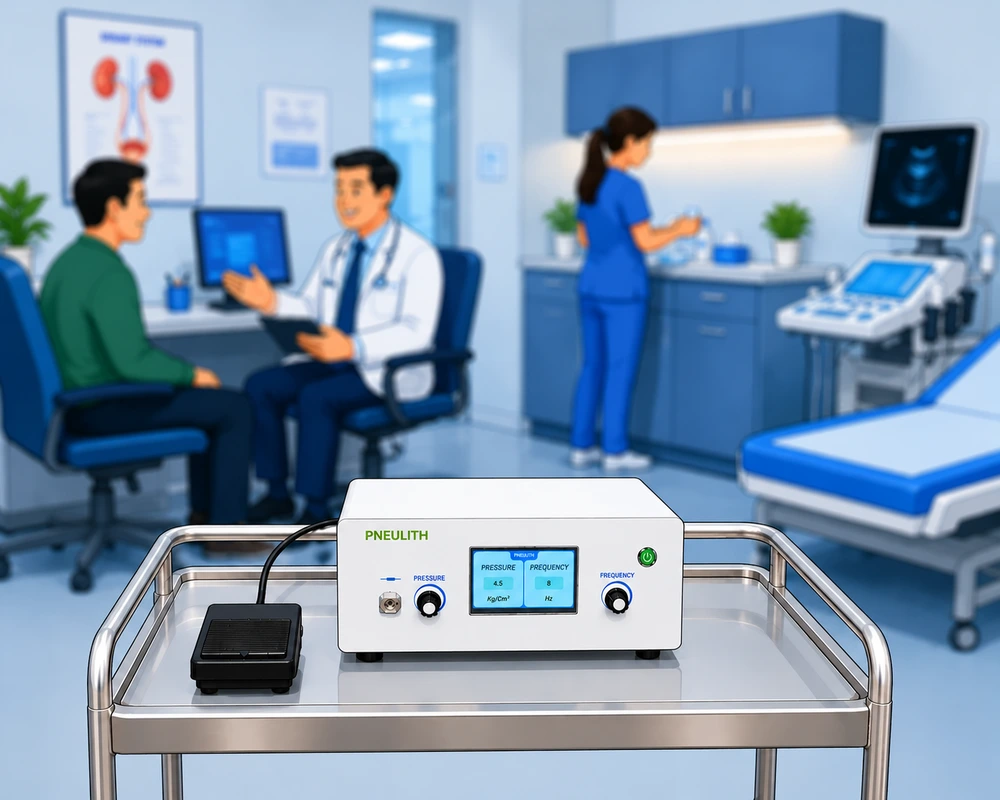
Energy consistency is critical for procedural efficiency. The Pneulith Digital Pneumatic Lithotripsy System uses electro-pneumatic regulation to maintain precise pressure delivery, enabling effective fragmentation across various stone types while supporting shorter procedures. Key pressure specifications:
- Working pressure: 1.8-4 kg/cm²
- Maximum input pressure: 6 kg/cm²
This ensures controlled force delivery across different stone densities while preserving control during delicate ureteroscopic work. The system’s ability to treat kidney, bladder, and ureteral stones demonstrates its versatility, giving clinical teams confidence in its ability to support multiple indications across diverse cases efficiently.
Digital Pneumatic Lithotripter Workflow Comparison
A Digital pneumatic lithotripter should be assessed not only by its fragmentation ability, but also by its total operational impact. Procurement teams comparing systems often prioritise usability, downtime risk, and standardisation benefits, which is why the Pneulith remains valuable for hospitals focused on uptime and standardisation.
| Procurement Factor | Pneulith Digital System | Typical Basic Units |
| User Interface | LCD real-time display | Basic panel |
| Pressure Control | Electro-pneumatic precision | Manual/basic |
| Predefined Programs | Yes | Limited |
| Safety Alerts | Low-pressure detection | Minimal |
| Handpiece Ergonomics | 150 g lightweight | Often heavier |
| Maintenance Demand | Low | Variable |
| Multi-User Readiness | High | Moderate |
Over time, these differences significantly influence productivity, staff confidence, and total ownership cost.
Digital Pneumatic Lithotripter Control
A modern digital pneumatic lithotripter should simplify daily operation. Pneulith features an intuitive LCD interface with real-time visibility of system parameters, enabling quick adjustments and reducing hesitation during procedures.
This is especially valuable in multi-user hospital environments where multiple surgeons and theatre teams operate the same system. Clear controls reduce onboarding time, improve standardisation, and limit avoidable user errors.
The device also supports custom user presets, allowing surgeons to store preferred pressure and frequency combinations and recall them instantly during procedures. That reduces manual setup steps and may help support more consistent procedural workflows.
Lithotripter for Ureteroscopy (URS)
A reliable Lithotripter for ureteroscopy (URS) must perform efficiently in narrow anatomy where visibility and timing are critical. Pneulith is well-suited for URS because it combines compact design, responsive pneumatic action, and clinically relevant probe options.
The available 0.8 mm, 1 mm, and 1.2 mm probes support ureterorenoscopy requirements, helping clinicians choose the appropriate size based on access and case complexity.
Its portability and compact footprint also make it ideal for facilities with multiple operating rooms or space constraints.
Rigid URS Lithotripter Device Benefits
Every Rigid URS lithotripter device must deliver long-term value. Pneulith is designed for seamless integration into existing hospital infrastructure:
- Power requirement: 230 VAC, 50 Hz
- Compatible with compressed air or pressurised oxygen
Handpiece specifications:
- Size: ~24 mm × 180 mm
- Weight: 150 g
For hospitals seeking durable daily performance, Pneulith combines compatibility with user comfort.
The unit’s automatic low-pressure detection enhances safety and supports uninterrupted operation, reassuring biomedical teams of dependable, trouble-free use and reducing service disruptions.
Why Pneulith Leads Competitors
While many systems generate pneumatic force, fewer combine intelligent control, ergonomics, and operational efficiency in one platform.
These product-specific differentiators directly matter to hospital procurement teams.
- True digital lithotripter system with intuitive LCD controls
- Automatic parameter loading after program selection
- Electro-pneumatic regulator for accurate pressure delivery
- Automatic low-pressure detection
- Lightweight ergonomic handpiece (150 g)
- Probe compatibility for URS, bladder, and renal cases
- Low-maintenance design
- Compact and portable design
While low-cost units compete solely on price, Pneulith is designed to support usability, workflow continuity, and long-term operational value.
Conclusion
Rigid URS remains an important stone management pathway, and equipment quality directly impacts efficiency, user experience, and ownership cost. Pneulith demonstrates the value of digitally controlled pneumatic systems by combining precise pressure regulation, ergonomic design, safety monitoring, and reliable fragmentation.
For hospitals and distributors seeking to support efficient urology department workflows, Pneulith offers a dependable, high-value solution for rigid URS applications. Contact us to know more.