Urology diagnostics have changed significantly over the last decade. Clinics are no longer looking only for accurate measurements. They also want equipment that improves efficiency, simplifies maintenance, and enhances the experience for both patients and healthcare professionals. This shift has placed self-cleaning uroflowmeters at the centre of conversations about modern diagnostic technology.
Every uroflowmetry test depends on a clean and reliable testing environment. While traditional cleaning procedures remain important, they often require staff time and introduce variations between tests. As patient volumes continue to grow, healthcare providers are seeking smarter solutions that maintain hygiene standards without slowing clinical operations.
Today, advanced uroflowmetry equipment integrates automation, wireless connectivity, cloud-based reporting, and intelligent design features, enabling accurate assessments of the lower urinary tract and supporting more efficient clinic operations.
Supporting Reliable Testing Conditions Daily
The biggest advantage of self-cleaning uroflowmeters is not simply that they stay clean. Their real value lies in creating a more consistent testing environment while supporting higher hygiene standards and reducing the burden of manual cleaning.
In traditional settings, cleaning procedures depend heavily on staff availability and adherence to protocols. Although these procedures are necessary, they can vary between operators and shifts. Automated cleaning technology helps reduce this variation by performing a standardised cleaning cycle after each test.
Advanced systems like Auto-Tersus Wireless Self-cleaning Uroflowmeter incorporate patented self-cleaning technology developed and protected in both India and the United States, automatically maintaining cleanliness between patient examinations to reduce manual cleaning and support operational efficiency.
This approach provides several practical advantages:
- Reduced manual cleaning requirements.
- Reduced maintenance through patented self-cleaning technology.
- Faster preparation for the next patient.
- Improved consistency between tests.
- Better support for infection-control protocols.
For busy hospitals and specialist clinics, these benefits extend beyond convenience. They help maintain operational continuity while supporting confidence in the testing environment.
Practical Uroflowmeter Hygiene Features
Healthcare facilities increasingly view uroflowmeter hygiene features as essential to diagnostic performance. Hygiene is no longer a secondary consideration added after design. It is now built directly into modern equipment architecture.
Advanced self-cleaning uroflowmeters are designed to minimise unnecessary handling while supporting a cleaner testing process. Automated cleaning functions reduce reliance on repetitive manual tasks and help establish a predictable maintenance routine.
Important hygiene-focused innovations include:
- Automated self-cleaning after each test.
- Reduced contact with testing components.
- Simplified cleaning protocols for staff.
- Hygienic collection system design.
- Lower risk of residue build-up.
- Consistent cleaning performance throughout the day.
These features become particularly valuable in high-volume environments where multiple patients undergo testing within a short period.
Beyond appearance, the goal is to maintain reliable testing conditions. Consistent hygiene practices help support equipment readiness while reducing interruptions caused by lengthy cleaning procedures.
Digital Uroflowmeter Enhances Connectivity
Unlike conventional systems that rely on multiple cable connections, wireless architecture provides greater flexibility during installation and daily operation. This makes the system suitable for both standalone urology clinics and larger hospital environments.
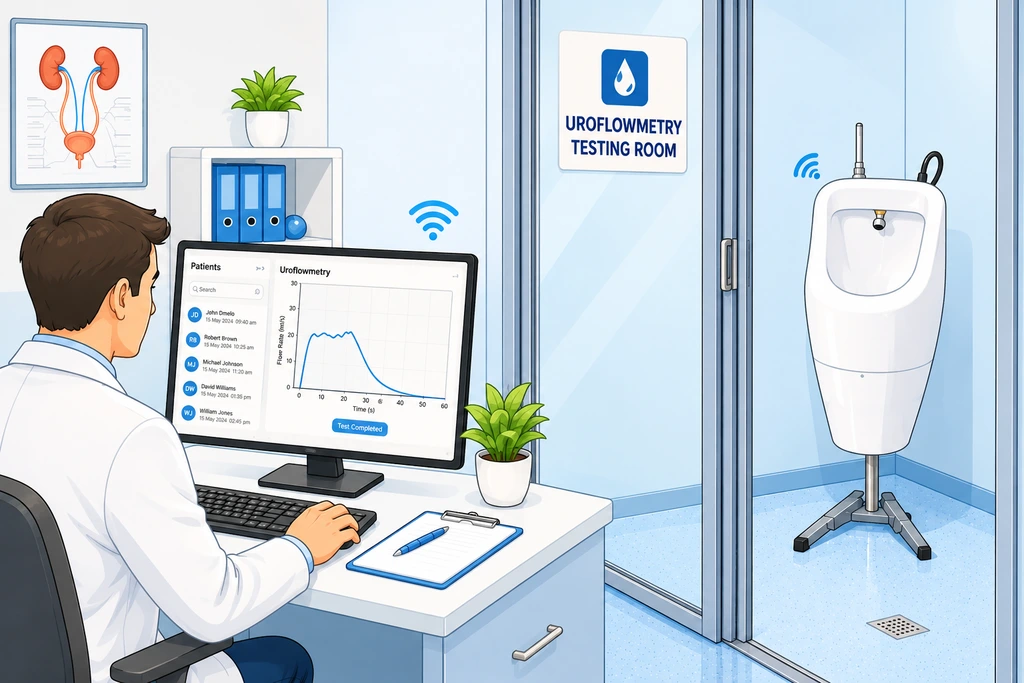
Real-time wireless data transfer allows clinicians to access test results immediately after completion, helping reduce reporting delays and improve decision-making.
Modern self-cleaning uroflowmeters combine seamless data management and wireless communication, helping clinicians access test results more efficiently while supporting smoother clinical workflows.
One of the most significant developments is wireless communication. Instead of relying on complex cable arrangements, advanced systems can transmit data wirelessly, creating a cleaner and more flexible clinical setup.
Modern digital platforms often provide:
| Digital Capability | Clinical Advantage |
| Wireless communication | Reduces cable dependency |
| Application-based operation | Simplifies workflow management |
| Android compatibility | Flexible device usage |
| Tablet integration | Improved mobility |
| Windows and laptop support | Easy clinical integration |
| Cloud-based reporting | Access reports from anywhere |
Cloud connectivity is particularly valuable in today’s healthcare environment. Clinicians can review reports from different locations, access historical records more efficiently, and support collaborative patient management when required.
Application-based controls provide a familiar interface for clinicians, making test administration, report review, and patient data management more convenient.
As healthcare systems continue moving toward digital integration, connectivity has become just as important as measurement accuracy.
Modern Uroflowmetry Systems Improve Reliability
Reliability remains one of the most important considerations when selecting diagnostic equipment. Regardless of how advanced a system appears, clinicians ultimately need confidence that results remain dependable over time.
Advanced self-cleaning uroflowmeters support reliability by reducing maintenance-related variability and helping maintain standardised testing conditions over time.
Advanced systems may also include a dedicated male urinal that supports natural standing voiding, helping create testing conditions that better reflect normal urinary behaviour. An optional Combo-Chair can comfortably accommodate both male and female patients, improving accessibility while maintaining consistent testing procedures.
This is where modern uroflowmetry systems demonstrate their value. Advanced technologies are designed to minimise variables that may affect testing conditions and support accurate data collection.
Several technical features contribute to long-term reliability:
| Technical Feature | Clinical Benefit |
| 24-bit ADC technology | Improved measurement precision |
| 10Hz sampling rate | Detailed flow pattern analysis |
| Wireless communication | Faster data transfer |
| Cloud reporting system | Better record accessibility |
| Automated cleaning cycle | Consistent testing conditions |
| Application-based operation | Reduced workflow complexity |
The inclusion of a 24-bit analogue-to-digital converter helps improve sensitivity during measurement. At a 10Hz sampling rate, the system can capture flow characteristics in greater detail, supporting more accurate evaluation of urinary function.
Many advanced systems, manufactured under CDSCO approval and IEC 60601-1 compliance, help clinicians feel confident in the equipment’s safety, quality, and long-term performance.
Reliable data collection becomes increasingly important when monitoring patients over time. Small changes in flow patterns can influence treatment decisions, making consistency a critical factor in clinical practice.
Advanced self-cleaning uroflowmeters support consistent diagnostic performance by maintaining standardised testing conditions and reducing variability caused by manual cleaning procedures. Combined with precise measurement technology, this helps clinicians make more confident assessments over time.
By combining automated hygiene, advanced electronics, and digital connectivity, modern systems create a stronger foundation for dependable diagnostic outcomes.
Clinical Workflow Efficiency In Practice
Many healthcare facilities invest in self-cleaning uroflowmeters because they help streamline day-to-day operations without adding complexity to clinical workflows.
Together, automated cleaning, wireless communication, and application-based controls help create a highly hygienic and hassle-free approach to uroflowmetry testing.
Healthcare providers continually seek ways to improve clinical workflow efficiency without compromising patient care. Even small operational improvements can have a meaningful impact throughout a busy clinic day.
The practical outcome includes:
- Faster patient turnaround.
- Reduced operational downtime.
- Improved equipment availability.
- Simplified report management.
- Enhanced staff productivity.
These improvements may seem small individually. However, when multiplied across dozens of patients each week, they can significantly influence overall clinic performance.
Healthcare organisations facing growing patient demand increasingly recognise workflow efficiency as a key factor in technology investment decisions.
Conclusion
The conversation around uroflowmetry has moved beyond basic hygiene. Today, self-cleaning uroflowmeters contribute to cleaner testing environments, improved workflow efficiency, enhanced patient experiences, stronger diagnostic consistency, and simplified maintenance. When combined with wireless communication, cloud-based reporting, application-driven operation, high-precision measurement technology, and patient-focused design, they represent a significant advancement in modern urology diagnostics.
To explore advanced uroflowmetry solutions featuring patented self-cleaning technology, wireless connectivity, cloud reporting, and a regulatory-compliant design, visit Status Medical Equipments and discover how the latest generation of uroflowmeters with self-cleaning technology can support your clinical practice.
Frequently Asked Questions
1. What makes self-cleaning uroflowmeters different from traditional systems?
Self-cleaning uroflowmeters automatically perform cleaning functions after testing, reducing manual intervention and helping maintain consistent hygiene standards. This improves operational efficiency while supporting a cleaner and more reliable diagnostic environment.
2. How do self-cleaning uroflowmeters support wireless connectivity?
Self-cleaning uroflowmeters can transfer test data wirelessly between the device and connected platforms. This reduces cable clutter, simplifies setup, improves accessibility, and supports smoother integration into modern clinical workflows.
3. Can self-cleaning uroflowmeters improve report accessibility?
Many self-cleaning uroflowmeters include cloud-based reporting capabilities that allow clinicians to access patient records and test reports from different locations. This improves collaboration and simplifies information management.
4. What role does a 24-bit ADC play in uroflowmetry?
A 24-bit analogue-to-digital converter improves measurement sensitivity by capturing detailed flow information. This helps clinicians analyse urinary patterns more accurately and supports reliable assessment of lower urinary tract function.
5. How do self-cleaning uroflowmeters support accurate testing?
Features such as dedicated male urinals, optional Combo-Chairs, and automated cleaning functions help create consistent testing conditions. These design elements contribute to more representative uroflowmetry results and reliable assessments.
6. Why are IEC 60601-1 and CDSCO compliance important?
IEC 60601-1 compliance addresses medical electrical safety requirements, while CDSCO approval demonstrates adherence to regulatory standards in India. Together, they provide confidence in device quality, safety, and clinical suitability.