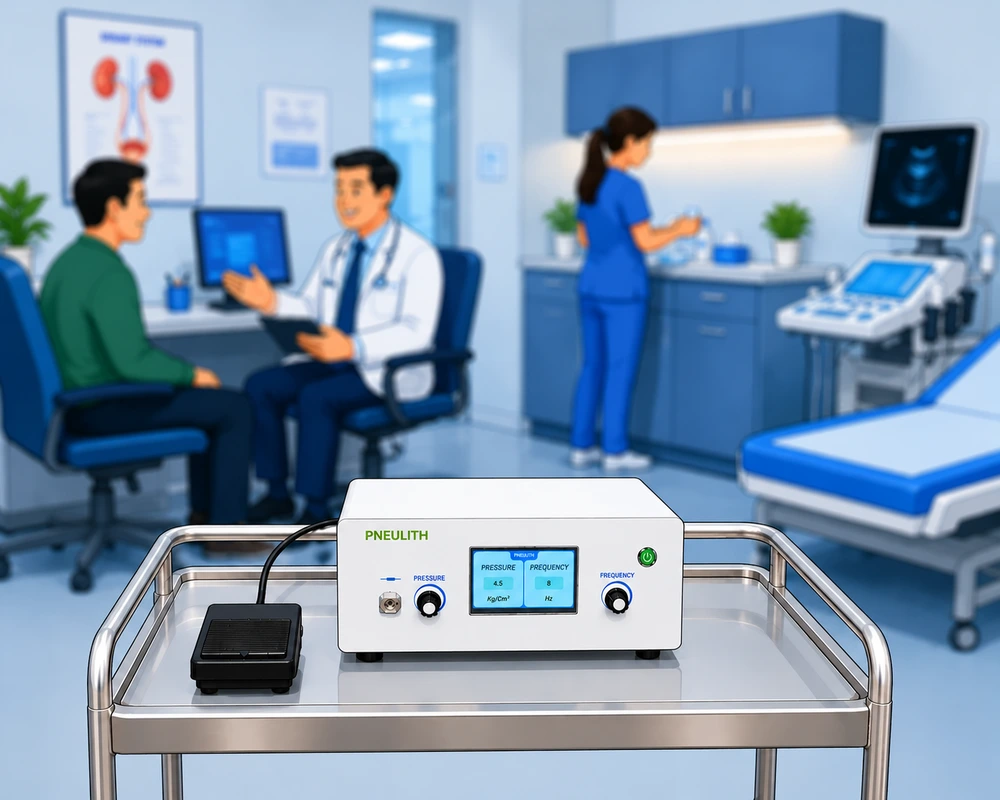

In most clinics, uroflowmetry itself is rarely the problem. The gaps tend to appear around how it is performed. A standalone uroflowmeter becomes relevant in these situations because it reduces system dependency rather than adding complexity.
In routine clinical use, factors such as system readiness, workflow continuity, and patient timing influence how consistently the test is conducted. Even small interruptions can affect repeatability, particularly across multiple patients.
This is where system design begins to matter. The difference between standalone and PC-based systems is not only technical; it directly affects consistency, workflow stability, and clinical confidence over time.
Standalone Uroflowmeter Workflow Reality
A standalone uroflowmeter is well-suited for clinical environments where consistency matters more than flexibility. It operates as a complete unit, so the process begins and ends within the same system without external coordination.
In daily practice, interruptions are rarely obvious but occur frequently. Systems may need to load, reconnect, or rely on external inputs before the test begins. These interruptions may seem minor, but across a full day of patients, they can significantly affect workflow continuity.
Standalone systems reduce these interruptions.
- The system is ready as soon as the patient is ready
- No dependency on external software or devices
- Reports are generated immediately after testing
- Staff do not need to switch between systems
- The process remains consistent across patients
Repeated use creates a more predictable workflow, with execution remaining stable regardless of surrounding conditions.
Standalone vs PC-Based Uroflowmeter Comparison
When comparing a standalone uroflowmeter vs a PC-based uroflowmeter, the difference becomes clearer through operational impact rather than specifications. The distinction is less about capability and more about how reliably each system performs in everyday use.
| Clinical Factor | Standalone System | PC-Based System |
| Test Readiness | Immediate | Dependent on system setup |
| Workflow Continuity | Smooth and uninterrupted | May pause between steps |
| Staff Involvement | Minimal | Requires coordination |
| Data Handling | Direct and localised | Linked to external systems |
| Downtime Risk | Lower | Higher due to dependencies |
| Repeat Testing | Easier to conduct | More setup required |
| Output Generation | Instant printing | Requires system processing |
In practice, PC-based systems can introduce variability due to their reliance on external systems. A standalone uroflowmeter reduces these variables, allowing more consistent execution across repeated tests.
Standalone Uroflowmetry Device Practical Benefits
A standalone uroflowmetry device’s simplicity reassures clinicians and decision-makers about process stability, fostering confidence in routine clinical use. Because the system operates independently, each test follows the same process without variation introduced by software updates, connectivity, or system conditions.
Transitions between patients remain smooth, allowing staff to manage the system without interruption and without switching between systems or dealing with technical issues. Across repeated use, this consistency of the standalone uroflowmeter supports more stable data, making longitudinal comparison across visits more dependable.
For clinicians, this means fewer variables influencing results and more confidence when interpreting changes in urinary flow patterns during follow-up evaluations.
Standalone Uroflowmetry System Reliability
A standalone uroflowmetry device enhances reliability by minimising operational variables, improving confidence in test accuracy, especially in borderline cases. When system-related variation is added, interpretation becomes less straightforward. Standalone systems address this by keeping measurement, processing, and output within a single unit.
Standalone systems minimise external dependencies, reducing delays and inconsistencies, while supporting more reliable and predictable testing conditions across repeated use.
This becomes particularly important during follow-up evaluations, where results need to be compared across sessions. By limiting system-related variation, the standalone uroflowmetry system enables clinicians to focus on patient-related changes rather than on test performance inconsistencies.
It is widely used in evaluating conditions such as benign prostatic hyperplasia (BPH), bladder outlet obstruction (BOO), neurogenic bladder, and post-operative urinary flow assessment. The standalone uroflowmeter complies with CDSCO regulatory requirements and is certified to IEC 60601-1 and ISO 13485, supporting safe and reliable clinical use.
Uroflowmeter with Dot Matrix Printer
A uroflowmeter with a dot matrix printer supports a part of the clinical workflow that often goes unnoticed: documentation. Even in digital environments, physical reports remain relevant for patient records, audits, and clinical review.
The advantage lies in reliability rather than presentation. Reports are generated immediately after testing without relying on external devices or connections, reducing dependency on additional infrastructure.
Unlike other printing methods, dot matrix output remains stable across repeated use, making it suitable for long-term record keeping. This is particularly useful in settings where documentation must be preserved for regulatory or clinical review purposes.
In a standalone uroflowmeter, automatic report printout immediately after test completion ensures that reporting remains part of the same workflow, avoiding delays or disruptions that may occur when external systems are involved.
Where PC-Based Systems Still Apply
PC-based systems serve environments where integration is required rather than simplicity. In such setups, data may need to be accessed across departments or connected with hospital information systems for broader clinical use. In these cases, centralised storage and access can facilitate collaboration among clinicians. However, these advantages also introduce additional layers of dependency.
The system relies on software installation, compatibility, and ongoing maintenance. Even minor issues such as updates, connectivity delays, or hardware mismatches can gradually degrade consistency.
In environments without dedicated technical support, this may influence workflow reliability. While PC-based systems offer integration benefits, a standalone uroflowmeter often provides a more stable alternative where consistency and ease of use are prioritised over system connectivity.
What Sets FlowComp® Apart in Practice
Most standalone gravimetric systems aim to simplify uroflowmetry, but in routine use, automation and consistency become the real differentiators. FlowComp® Standalone Uroflowmeter is engineered to address these practical gaps directly within a standalone uroflowmeter design. Many standalone systems still rely on manual triggering or external interpretation, which can introduce variation in routine testing.
- Gravimetric technology ensures reliable weight-based measurement of flow and volume.
- Fully automated auto-start and auto-stop detection captures voiding data without manual input.
- Built-in clinical nomograms support immediate interpretation during routine evaluation.
- A high-performance microprocessor with dedicated signal processing ensures high accuracy in flow and volume measurement.
- Zero-maintenance design reduces downtime and supports uninterrupted clinical use.
- True standalone operation removes dependency on external systems.
In practice, these features standardise how each test is conducted. The system manages detection, measurement, and reporting within one controlled workflow, reducing variation caused by manual handling.
This becomes especially relevant during repeat evaluations, where consistency across sessions influences interpretation. With over 1,200 installations and 60,000 tests conducted, FlowComp® demonstrates reliable real-world performance and is well-suited for clinical environments that prioritise stability, ease of use, and minimal system dependency.
Conclusion
The choice between standalone and PC-based systems is not only about capability. It is about how consistently the system performs under everyday conditions. A standalone uroflowmeter reduces dependency, simplifies workflow, and supports repeatable testing without adding operational complexity.
Across repeated use, this consistency translates into stronger clinical confidence. When the system behaves predictably, interpretation becomes clearer, and decision-making becomes more reliable.
If your goal is to improve both workflow efficiency and diagnostic consistency, it is worth evaluating systems designed for stable, independent performance. Contact our team to evaluate how a standalone uroflowmeter can improve workflow consistency and reduce operational dependency in your clinical environment.
FAQs:
A standalone uroflowmeter operates independently without relying on external systems. This reduces delays, simplifies operation, and ensures that each test follows a consistent process.
Automated features such as start and stop detection reduce manual intervention. This helps standardise data capture, minimises user-related variation, and supports more reliable interpretation of urinary flow patterns.
Yes. Because they reduce system-related variability, standalone systems allow tests to be conducted under similar conditions across sessions, making comparison of results more dependable in follow-up evaluations.