A busy urology department can rarely afford unexpected downtime. Every diagnostic system is expected to deliver accurate, reliable results from the first patient appointment of the day to the last. That expectation doesn’t depend on manufacturing quality alone. Urology equipment maintenance plays an equally important role in keeping equipment reliable throughout years of daily clinical use.
Most performance issues do not begin with a sudden failure. Instead, they develop gradually. A connector is attached and removed hundreds of times, calibration gradually shifts, or a sensor starts behaving differently after years of continuous use. None of these changes immediately stops the equipment from functioning, which is why they often go unnoticed during routine clinical use. Over time, however, they can influence reliability if regular inspections fail to identify them early.
Preventive maintenance is more than a routine service activity. It involves practical decisions that help biomedical teams protect equipment performance throughout its lifecycle. The following tips explain how healthcare facilities can reduce unexpected downtime, improve reliability, and extend the life of their urology equipment.
Build a Usage-Based Maintenance Plan
Most hospitals don’t notice changes in equipment performance from one day to the next. The changes are usually gradual, which is exactly why urology equipment maintenance deserves more attention than emergency repairs. While high-quality engineering ensures dependable performance from the beginning, daily use gradually changes how equipment behaves. Components experience normal wear, accessories are repeatedly connected and disconnected, and environmental conditions affect sensitive electronic systems. None of these changes is unusual, but they do require attention if long-term performance is expected.
Scheduled inspections often reveal details that are easy to miss during a busy clinic. Equipment may still be operating normally, yet service records begin showing patterns that deserve closer attention. Consider a uroflowmetry system that supports patient testing throughout the day. Clinicians may never notice a difference in day-to-day operation, but maintenance records can tell another story. If every scheduled service requires slightly more calibration adjustment than the previous one, engineers know it’s time to investigate before that gradual change begins affecting diagnostic consistency.
Maintenance records often reveal patterns that a single inspection cannot. Recurring calibration adjustments or repeated accessory replacements help engineers identify developing issues before they affect clinical performance.
Rather than waiting until equipment performance becomes inconsistent, urology equipment maintenance helps healthcare providers understand how their systems change under normal operating conditions. This proactive approach protects equipment reliability while allowing biomedical teams to resolve minor technical issues before they disrupt clinical workflows.
Equipment that remains in a dedicated diagnostic room experiences different levels of stress than systems that are frequently moved between departments or used in high-volume clinical environments. Maintenance schedules should reflect these practical differences because equipment usage often influences servicing priorities as much as equipment age.
Identify Small Changes Before Failures
Reliability isn’t something biomedical teams leave to chance. By the time a system begins showing obvious symptoms, the underlying change has often been developing for months. Urology equipment maintenance is built around careful observation, planned servicing, and timely intervention that help identify these gradual changes early. Preventive servicing is not performed because something has already failed. It is performed to confirm that everything continues operating as intended.
An effective Preventive maintenance program for urology equipment begins long before technicians open a service panel. Before opening the equipment, experienced engineers usually watch how it behaves during routine operation. Small differences in startup time, connector stability, or calibration trends often provide better clues than fault messages alone.
Is the startup taking slightly longer than expected? Has a connector become less secure after repeated use? Are calibration adjustments becoming more frequent than previous maintenance records suggest? Small observations like these often provide the earliest indication that equipment performance is beginning to change.
A structured preventive maintenance program commonly includes:
- Careful visual inspection of accessories, connectors, and external components.
- Functional testing to verify stable operation before clinical use.
- Calibration according to manufacturer recommendations and actual equipment usage.
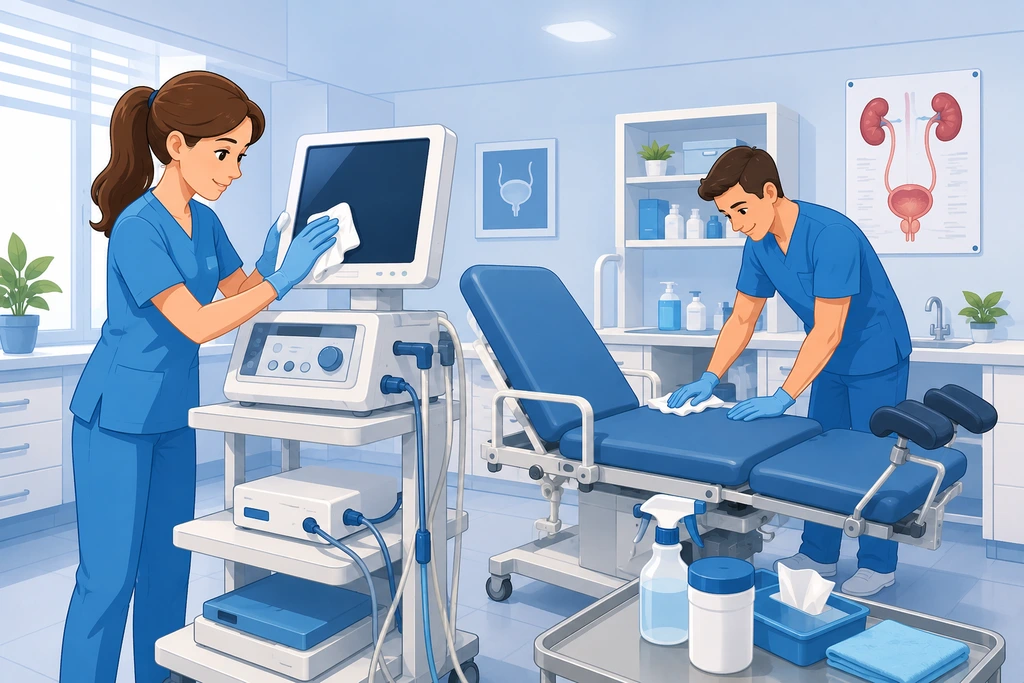
- Cleaning procedures designed to protect sensitive components without affecting performance.
- Detailed maintenance documentation that supports future technical evaluations.
The difference becomes clear after several years of everyday clinical use. It’s common to see two identical systems performing very differently, even when they were installed at the same time. The difference usually isn’t the equipment itself. It depends on how frequently the system is used and how consistently urology equipment maintenance is carried out. One facility follows a planned maintenance schedule and documents every inspection, while the other delays servicing until noticeable issues arise. Both systems remain operational, but the first is far more likely to deliver consistent performance because gradual changes were identified long before they developed into service calls.
Match Maintenance to Equipment Usage
No two healthcare facilities use their equipment in exactly the same way. Matching maintenance schedules to actual equipment usage helps prevent unnecessary servicing while ensuring heavily used systems receive timely attention. Urology equipment maintenance becomes more effective when inspection intervals reflect workload instead of fixed calendar dates.
Two healthcare facilities may install the same uroflowmeter, yet their maintenance requirements can be entirely different. A diagnostic centre performing ten patient studies a day, places far less demand on the system than a tertiary hospital, where the equipment operates almost continuously. Treating both systems identically may seem practical, but it rarely delivers the best long-term results. Maintenance intervals should reflect actual usage rather than simply following a calendar.
Equipment may also be moved between consultation rooms, cleaned several times each day, or transported between departments. None of these activities causes immediate damage, but together they gradually shape how the system performs over time. These changes develop slowly, making them difficult to recognise in routine clinical practice. That is why many biomedical teams encourage clinicians to report even minor observations, such as connectors feeling less secure or startup times becoming slightly longer than usual. Small details often provide valuable clues before measurable performance changes appear.
Instead of viewing maintenance as an interruption to daily operations, many hospitals now consider it part of their equipment management strategy. Planned inspections help maintain reliability while reducing the likelihood of unexpected technical issues. Urology equipment maintenance supports consistent diagnostics by keeping equipment operating within its intended performance range throughout its lifecycle.
Standardise Every Maintenance Inspection
A maintenance checklist should do more than confirm that servicing has been completed. It should help engineers identify gradual changes that could influence long-term equipment performance before they develop into larger technical concerns.
Follow the manufacturer’s recommended service procedures and recognised quality management standards, including ISO 13485, to support reliable urology equipment maintenance.
section.
| Maintenance Activity | What Engineers Assess | Long-Term Performance Benefit |
| Visual inspection | Connectors, accessories, external wear | Identifies developing issues before they affect operation |
| Functional testing | Overall system performance | Confirms dependable operation before clinical use |
| Calibration verification | Measurement consistency | Preserves reliable diagnostic accuracy |
| Approved cleaning procedures | Condition of sensitive components | Minimises premature wear caused by contamination |
| Scheduled preventive servicing | Mechanical and electronic stability | Reduces unexpected downtime and extends equipment life |
| Maintenance documentation | Equipment service history | Supports future planning and technical decision-making |
Biomedical engineers can identify recurring calibration adjustments, repeated accessory replacements, or environmental factors influencing performance. These observations help maintenance teams address underlying causes instead of repeatedly correcting the same symptoms.
When maintenance decisions are guided by long-term equipment history rather than isolated inspections, urology equipment maintenance becomes a practical strategy for sustaining reliable performance rather than merely responding to service requirements.
Encourage Early Reporting by Staff
Biomedical engineers are not the only professionals responsible for identifying and developing equipment issues. Clinicians and technicians interact with diagnostic systems throughout the day, making them the first to notice small changes. Reporting those observations early allows urology equipment maintenance to address potential problems before they affect clinical performance.
Simple practices that support long-term reliability include:
- Report unusual operating behaviour as soon as it is noticed rather than waiting for performance to deteriorate.
- Record every inspection, calibration, and repair to establish a reliable maintenance history.
- Follow the manufacturer’s recommended handling and cleaning procedures during daily operation.
- Replace worn accessories before they begin affecting equipment performance.
- Plan preventive servicing around patient schedules to minimise disruption without delaying essential maintenance.
A useful example comes from a hospital where engineers repeatedly replaced the same connector on a frequently used uroflowmeter. Initially, the connector itself appeared to be the problem. After reviewing several years of maintenance records, however, the team discovered that unstable power supplied through an extension unit was placing unnecessary stress on the equipment. Once the electrical issue was corrected, connector replacements became far less frequent. The solution came from understanding equipment behaviour rather than replacing additional parts.
A single major repair rarely preserves long-term reliability. It is achieved through many small maintenance decisions made consistently over time. By combining good operating practices with manufacturer guidance, urology equipment maintenance helps healthcare facilities protect equipment performance, reduce avoidable service interruptions, and maximise the value of their investment.
Conclusion
Hospitals invest in quality urology equipment, expecting years of dependable performance. Urology equipment maintenance protects that investment by identifying small changes before they become larger technical problems. Consistent inspections, timely servicing, and accurate maintenance records help keep equipment reliable while supporting uninterrupted patient care.
If you’re looking for advanced urology equipment backed by experienced engineering, reliable preventive service support, and long-term technical expertise, contact Status Medical Equipments to discover solutions designed for dependable performance in demanding clinical environments.
Frequently Asked Questions
1. Why is preventive maintenance important for urology equipment?
Urology equipment maintenance helps identify gradual performance changes before they affect clinical workflows. Regular inspections, calibration, and servicing maintain equipment reliability, minimise unexpected downtime, and support consistent diagnostic accuracy throughout the equipment’s operational life.
2. How often should urology equipment be serviced?
The frequency of urology equipment maintenance depends on equipment type, patient volume, operating environment, and manufacturer recommendations. Facilities with higher equipment usage often require more frequent inspections to preserve reliable long-term performance and minimise operational disruptions.
3. What are the early signs that equipment requires maintenance?
Common signs that urology equipment maintenance is needed include repeated calibration adjustments, slower startup times, unusual operating sounds, inconsistent measurements, worn accessories, or recurring warning messages that may affect clinical performance.
4. Can preventive maintenance reduce repair costs?
Yes. Urology equipment maintenance helps identify small technical concerns during planned servicing, preventing major component failures, reducing emergency repair costs, minimising equipment downtime, and extending the useful life of valuable medical systems.
5. Who should perform preventive maintenance on urology equipment?
Routine visual inspections may be completed by trained healthcare staff. However, urology equipment maintenance, including calibration, software validation, technical servicing, and repairs, should always be performed by qualified biomedical engineers or manufacturer-authorised service professionals following recommended service procedures.
6. Why are maintenance records important for long-term equipment performance?
Maintenance records are an essential part of urology equipment maintenance because they provide valuable insight into equipment behaviour over time. Reviewing service history helps identify recurring trends, optimise maintenance schedules, improve troubleshooting, and support informed technical decisions that keep equipment performing consistently for years.