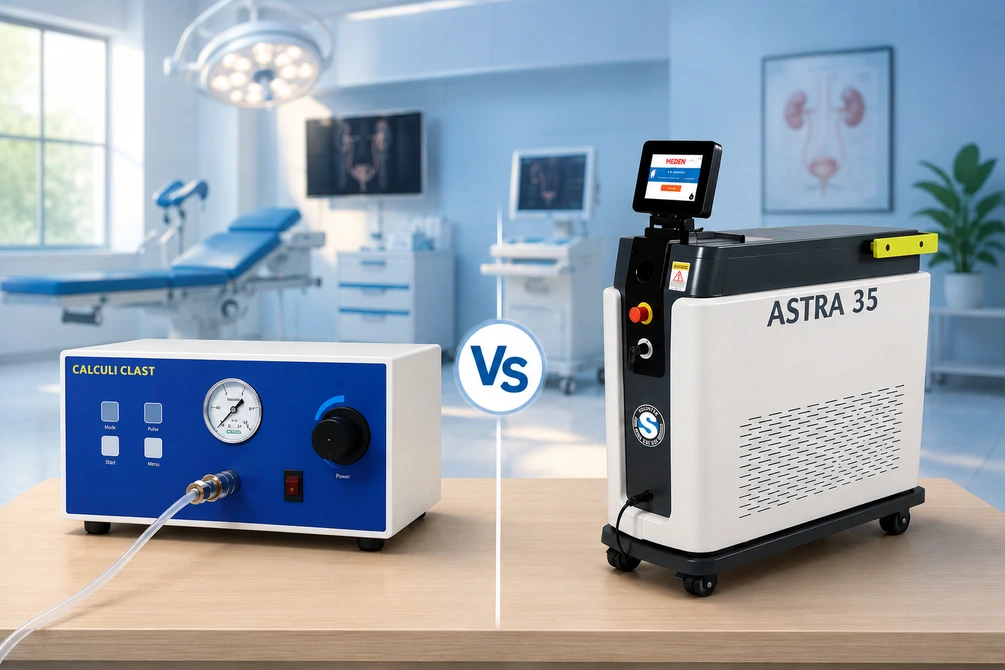
Stone disease management continues to evolve, yet one question remains common in urology departments worldwide: should a surgeon choose laser technology or pneumatic lithotripsy for effective stone fragmentation? Both approaches have earned their place in modern endourology, but the right choice often depends on more than technology alone.
Today’s urologists must balance clinical outcomes, procedure efficiency, equipment investment, maintenance requirements, and patient expectations. While laser systems have gained popularity for their versatility, pneumatic devices remain widely used because they continue to deliver dependable fragmentation performance across a broad range of stone cases.
Choosing between laser and pneumatic technologies requires more than comparing technical specifications. Factors such as stone characteristics, procedural efficiency, equipment costs, and long-term reliability all influence the decision-making process. The field of intracorporeal lithotripsy has evolved significantly, giving urologists access to both technologies. While laser systems have expanded treatment options for flexible ureteroscopy and stone dusting, modern pneumatic lithotripsy systems continue to improve through better ergonomics, energy delivery, probe stability, and workflow integration.
Why Pneumatic Lithotripsy Still Matters in Modern Stone Management
Despite significant advancements in laser technology, pneumatic lithotripsy remains a preferred option in many hospitals, stone centres, and urology departments. The reason is straightforward: it provides powerful mechanical fragmentation, reliable performance, and cost-effective operation.
Unlike laser systems that use thermal energy to break stones, pneumatic devices generate kinetic energy through compressed air or oxygen. Calculiclast uses a ballistic energy-transfer mechanism in which compressed air accelerates an internal projectile, delivering controlled kinetic energy to the probe tip for effective stone fragmentation. This energy is transferred to the probe tip, producing high-impact impulses that efficiently fragment urinary calculi. Since the process involves minimal heat generation, the risk of thermal tissue injury associated with energy-based lithotripsy systems is largely avoided.
Modern pneumatic systems have also become increasingly refined over the years. Advances in energy delivery, probe design, and workflow integration have improved procedural efficiency while maintaining the core advantages that continue to make pneumatic technology relevant in contemporary stone management.
For many facilities, particularly those managing large patient volumes, the continued relevance of pneumatic lithotripsy lies in its balance of performance, simplicity, and long-term value.
Pneumatic Lithotripter Performance Factors
Several design factors influence overall performance:
- Adjustable blast power allows surgeons to tailor fragmentation intensity according to stone characteristics.
- Four preset pulse frequency options provide flexibility between controlled impact and continuous fragmentation.
- Stable probe positioning helps maintain targeting accuracy, while controlled energy delivery assists in minimising stone migration during fragmentation.
- Lightweight handpiece construction improves manoeuvrability throughout longer procedures.
- Compatibility with compressed air or pressurised oxygen sources increases operational flexibility.
- Low-maintenance design supports consistent clinical availability.
The system incorporates these characteristics within a compact handpiece measuring approximately 24 mm by 180 mm and weighing around 150 grams. This lightweight design contributes to comfortable handling while maintaining effective energy transmission.
Comparing Pneumatic Stone Fragmentation Outcomes
The effectiveness of pneumatic stone fragmentation is especially evident when treating dense or hard urinary calculi, giving clinicians confidence in its clinical performance against challenging cases.
Several clinical advantages influence treatment outcomes:
- Designed for effective fragmentation of urinary calculi during endoscopic procedures.
- Minimal heat generation during stone fragmentation.
- Immediate visual confirmation of fragmentation progress.
- Autoclavable components support standard sterilisation protocols.
- Compatible with ureteroscopic stone management.
- Suitable for use across kidney, ureteric, and bladder stone applications.
Pneumatic lithotripsy is particularly effective in cases where rapid fragmentation is a priority. In busy stone centres, efficient stone breakdown and extraction can contribute to smoother procedural workflows and improved theatre utilisation.
Laser vs Pneumatic Lithotripsy Comparison
Selecting the right technology requires careful consideration of clinical, operational, and financial factors.
| Factor | Laser Lithotripsy | Pneumatic Lithotripsy |
| Energy Source | Laser energy | Compressed air or oxygen-driven kinetic energy |
| Heat Generation | Present | Minimal heat generation |
| Stone Dusting Capability | Excellent | Limited |
| Hard Stone Fragmentation | Good | Excellent |
| Fragment Size | Fine particles | Larger removable fragments |
| Capital Investment | Higher | Lower |
| Maintenance Requirements | Higher | Lower |
| Consumable Costs | Higher | Lower |
| Infrastructure Needs | More complex | Simpler |
| Workflow Simplicity | Moderate | High |
| High-Volume Centres | Effective | Highly cost-efficient |
The choice ultimately depends on treatment objectives. While laser systems offer versatility, many institutions continue to value the practicality and dependability of pneumatic stone fragmentation systems, especially when managing high procedural volumes.
Laser vs Pneumatic Lithotripsy: Which Technology Fits Your Practice
Not every healthcare facility has identical requirements. Procedure volumes, available resources, surgeon preferences, and patient demographics all influence technology selection.
| Practice Environment | Recommended Consideration |
| High-volume stone centre | Pneumatic Lithotripsy |
| Budget-conscious hospital | Pneumatic Lithotripsy |
| Regional healthcare facility | Pneumatic Lithotripsy |
| Flexible ureteroscopy-focused practice | Laser Lithotripsy |
| Advanced tertiary referral centre | A combination of both technologies |
| Multi-speciality hospital | Depends on case mix |
Choosing a Pneumatic Lithotripsy System
Selecting a pneumatic lithotripsy system involves more than comparing specifications. Urologists should evaluate versatility, service support, workflow compatibility, and long-term ownership costs.
Modern systems such as Calculiclast Intra-corporeal Pneumatic Lithotripter support multiple probe configurations, including 0.8 mm, 1.0 mm, and 1.2 mm probes for ureterorenoscopy, 1.5 mm probes for bladder stone treatment, and 2.0 mm probes for renal stone treatment and PCNL procedures.
This flexibility enables treatment of:
- Kidney stones.
- Ureteric stones.
- Bladder stones.
The handpiece and probes are autoclavable and designed to comply with standard sterilisation protocols, helping facilities maintain infection-control standards while enabling efficient clinical workflows.
Compatibility with standard rigid and semi-rigid endoscopes allows many hospitals to introduce the stone fragmentation technology without replacing existing endoscopic equipment.
Another practical advantage is infrastructure flexibility. Calculiclast can operate using compressed air or pressurised oxygen and is available with an oil-less, low-noise compressor mounted on a mobile trolley. The trolley-mounted configuration allows easy movement between operating rooms and procedure suites, supporting efficient workflow management in busy hospitals while maintaining reliable performance.
When evaluating a pneumatic lithotripter, healthcare facilities should also consider technical support, spare parts availability, training requirements, and the manufacturer’s experience.
Reliability, Compliance and Long-Term Value
Beyond clinical outcomes, the long-term reliability of a pneumatic lithotripsy platform can significantly influence purchasing decisions. Technology selection increasingly involves assessing operational reliability rather than focusing solely on immediate clinical performance.
Having supported the urological fraternity for more than three decades, Status Medical Equipments has continually refined its pneumatic stone fragmentation technology in response to real-world clinical requirements. This long-standing experience has helped shape solutions that combine reliability, ease of use, and consistent clinical performance. Systems such as Calculiclast are designed for durability, straightforward maintenance, and consistent performance across demanding treatment environments.
Calculiclast is manufactured under an ISO 13485:2016 quality management system, holds CDSCO manufacturing approval, and complies with IEC 60601-1 medical electrical equipment safety standards.
For many institutions, these factors are just as important as fragmentation performance. Equipment reliability, regulatory compliance, service accessibility, and operational efficiency all contribute to the overall value proposition of pneumatic lithotripsy.
Conclusion
Laser and pneumatic technologies both play important roles in modern stone management. Laser systems offer exceptional versatility and dusting capabilities, while pneumatic devices continue to deliver powerful fragmentation, lower ownership costs, and dependable clinical performance. For urologists evaluating treatment technologies, the decision should be guided by stone characteristics, procedural goals, workflow requirements, and long-term value rather than technological trends alone. In many clinical environments, pneumatic lithotripsy remains a highly effective and practical solution.
To learn more about Calculiclast and discover how advanced pneumatic stone fragmentation technology can support your urology practice, contact Status Medical Equipments today to explore the complete product range.