
EMG-Guided Biofeedback in Pelvic Floor Rehabilitation Practice
Biofeedback in pelvic floor rehabilitation has progressed from a supplementary technique to an essential part of clinical practice. It now plays an important role in delivering structured and effective pelvic health treatment. Biofeedback pelvic floor rehabilitation adoption is increasing in clinics and delivers diagnostic accuracy and consistency across treatment protocols.
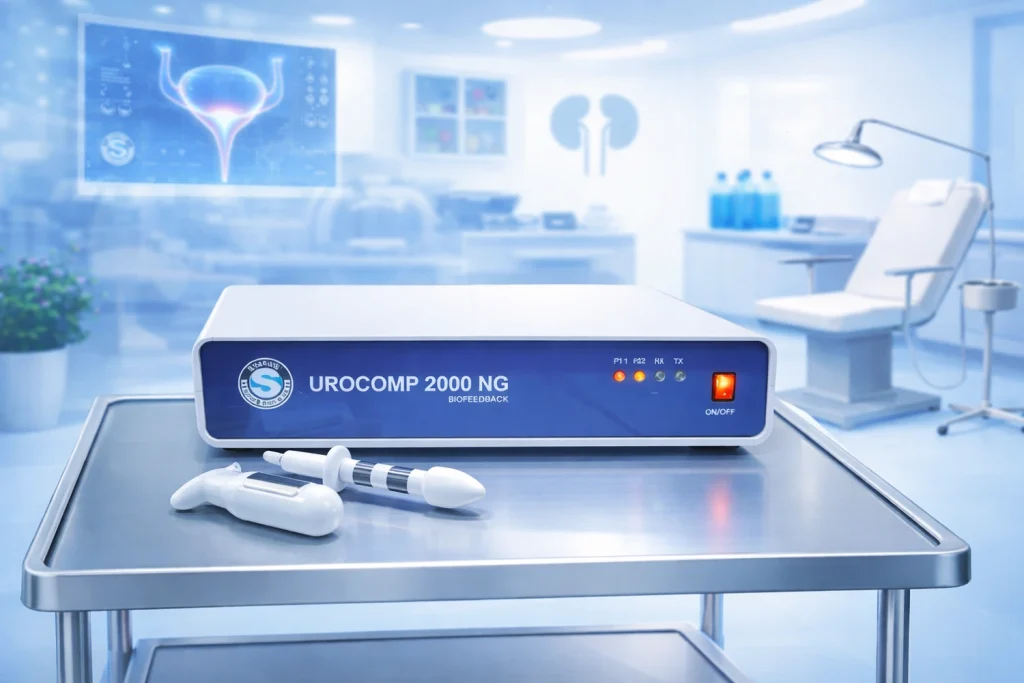
For specialists like urologists, urogynecologists, and pelvic health professionals, clinical decisions are increasingly reliant on more structured and effective solutions for pelvic healthcare. Biofeedback in pelvic floor rehabilitation is ideal and provides accurate measures. These measures are helpful to understand muscle timing, coordination, endurance, and relaxation quality. The Biofeedback module from the NG UROCOMP-2000 device is well-suited for Pelvic floor rehabilitation, meets all requirements, and is utilised for both evaluation and therapy with high accuracy.
Objective Evaluation via the Integration of EMG and Manometry
A complete evaluation of the pelvic floor needs to assess both neuromuscular activation and mechanical response simultaneously. Dual-channel EMG enables simultaneous monitoring of two different muscle sites. The biofeedback module of the NG UROCOMP-2000 system enables this by using dual-channel EMG to assess muscle activity, timing, balance, and coordination within a specific muscle group. Single-channel manometry measures pressure generation during functional tasks, providing insight into the mechanical output of muscle contractions.
When used together, these tools offer a clearer understanding for the clinician in pelvic health. Especially in cases where the muscle may show electrical activity on EMG but fail to generate adequate pressure, or the opposite may occur. This integrated method makes diagnosis easier, especially when electrical activation and mechanical output don’t match.
EMG and pressure measurement together give a more complete and reliable picture of pelvic floor function. Biofeedback in pelvic floor rehabilitation shows how well the muscles are activating, while pressure data shows whether that activation is producing effective force. When these two sets of information are combined, it reduces guesswork, closes gaps in the interpretation, and allows clinicians to select the most appropriate rehabilitation approach early in treatment rather than relying on trial and error.
Evaluation Mode: Effective pelvic floor rehabilitation requires an accurate baseline assessment before treatment begins. The biofeedback in pelvic floor rehabilitation supports this process by enabling standardised evaluation of key clinical indicators, including resting muscle tone and peak electrical activity. This is also beneficial for measuring contraction sustainability and the relaxation response, which are essential for planning targeted therapy.
NG UROCOMP-2000 biofeedback provides evaluation data, which can be saved in PDF form, and is accessible and can be reviewed over time to track genuine neuromuscular changes throughout rehabilitation, rather than relying on subjective observation alone. This data-driven approach is helpful for clinical decision-making and consistent treatment planning in specialist practice.
Therapy Mode: Transforming Assessment Data into Focused Rehabilitation
The therapy mode of the NG UROCOMP-2000 biofeedback system converts assessment results into structured rehabilitation tasks in less time than other EMG-guided systems. With this device, clinicians can give clear visual guidance and audio feedback to support accurate muscle engagement that prevents generic exercise prescriptions. This allows EMG-guided pelvic floor therapy to progress according to actual functional ability rather than symptoms alone. The data-driven biofeedback by NG Urocomp 2000 allows neuromuscular training instead of repetitive routines. These properties of biofeedback in pelvic floor rehabilitation make therapy sessions more efficient and improve consistency across protocols.
Real-Time Muscle Feedback for Motor Re-learning
Biofeedback in pelvic floor rehabilitation excellently delivers clearer, task-specific feedback in real time instead of regular static signal display. Most of the conventional systems lack correct timing while showing muscle activity, and become less useful and reliable. The inaccuracy in timing, coordination, or relaxation is responsible for the error. The NG Urocomp 2000 biofeedback device efficiently performs in real time and helps professionals to identify issues immediately and adjust guidance. This factor is crucial for motor re-learning in pelvic floor rehabilitation to prevent reinforcement of faulty movement patterns.
This feedback loop lets you quickly adjust your compensatory tactics, preventing you from reinforcing ineffective routines. In coordination-dependent pelvic floor dysfunction treatment, this level of accuracy shortens the time required to learn and improves task accuracy.
Handling High-Tone and Pain-Dominant Presentations
High-tone pelvic floor conditions require carefully controlled down-training and precise monitoring of muscle relaxation. EMG-guided systems enable clinicians to objectively identify elevated resting muscle activity and accurately assess relaxation thresholds, removing reliance on subjective evaluation.
Through visual and auditory feedback, patients can clearly recognise when true muscle relaxation is achieved during exercises, rather than depending solely on symptom perception. This is particularly beneficial in pain-dominant cases, where excessive muscle activation can aggravate symptoms.
Biofeedback in pelvic floor rehabilitation supports the delivery of targeted relaxation strategies, allowing therapists to implement treatment with greater accuracy, safety, and consistency.
Helping the Pelvic Floor Heal After Surgery
Effective postoperative rehabilitation highly relies on precise and real-time monitoring. That helps to protect healing tissues and, most importantly, to prevent symptom escalation after surgery. The NG Urocomp 2000 biofeedback device is good for real-time results and provides information on muscle recruitment quality, fatigue responses, and endurance limits. With this real-time data, clinicians can guide early recovery safely and quickly.
In cases like post-prostatectomy or pelvic reconstructive surgery, biofeedback devices play a key role and deliver graded activation with accurate EMG signals. On the other hand, its integrated manometry verifies controlled pressure generation. This type of accurate and real-time dual feedback reduces the risk of over-recruitment during vulnerable stages of healing. The controlled framework of this tool makes it a valuable tool in planned surgical recovery protocols.
How NG Urocomp 2000 Biofeedback Stands Out
A lot of biofeedback devices on the market only give feedback on one parameter, which makes it harder to use in a therapeutic setting. The NG Urocomp 2000 biofeedback device is a complete pelvic floor platform that combines dual-channel EMG and single-channel manometry into one system.
The technology enhances protocol accuracy and minimises assessment gaps by simultaneously recording electrical activity and mechanical reaction. This combined design gives you measurable clinical value that goes beyond just feedback tools.
Key Clinical Benefits Compared to Typical Market Options
- Dual-channel EMG for measuring neuromuscular activity at two sites
- Integrated manometry for verifying pressure
- Special evaluation mode for baseline testing
- Therapy mode matched up with earlier evaluation data.
- Visual and acoustic feedback that helps with accurate motor re-education
- Interactive PDF reports for keeping records and audits
- Multiple probes that work with different pelvic floor presentations
Conclusion
Biofeedback in pelvic floor rehabilitation is becoming an essential tool for urologists and pelvic health experts. If you are looking for efficient EMG-guided biofeedback devices that deliver consistent performance, reliable accuracy, and a smooth clinical workflow. Our NG Urocomp 2000 biofeedback system is ideal for pelvic health practice in daily life. The technical specifications, PDF reports and structured therapy are essential for confident clinical decisions.
Our biofeedback device for pelvic floor rehabilitation has modular parts that can be used for a variety of clinical settings. These include vaginal EMG probes, rectal EMG probes, and a balloon catheter for pressure-based evaluation. The small control unit and easy-to-use interface make it easy to add to outpatient clinics and hospital-based rehab settings.
Status Medical Equipments specialises in advanced urology equipments, with a comprehensive range of advanced urological solutions including high-precision uroflowmetry systems, next-generation urodynamic measurement systems, and modular diagnostic tools that support cystometry, pressure-flow studies, and EMG. To equip your outpatient clinic or hospital with reliable, innovative devices and tailored support, request a quote today and connect with our team for personalised product information and pricing.
FAQs:
It is mainly utilised for urinary incontinence and coordination-related pelvic pain. But it is also used for post-prostatectomy muscle retraining, pelvic floor dyssynergia, and complex pelvic floor dysfunctions.
Evaluation mode is used to assess baseline muscle function and generate structured reports. Therapy mode uses this data to guide targeted rehabilitation tasks with visual and audio feedback.